L'Etudie des Artes

It’s my first time at the Louvre on this adventure. I’ve been twice before, making mad dashes to see La Jocanda, but that wasn’t my intention this morning. I just wanted to pick a wing and observe for as long as I could, knowing I’d be overwhelmed by creative genius and my own supposed mediocrity in a couple of hours.
I’ve never felt more entitled than when I flashed my membership card to the security guard at the pyramid and he directed me to a line with no one in it. I bypassed people who had tickets and who didn’t and all who been waiting for a while. I pretty much swam in my own lane while every one else did their best “salmon swimming upstream during mating season” impression. Nothing to give you a big head like line jumping. And then, like everything else in my life, I immediately got knocked down a peg. I presented my card at the entrance of the Richelieu wing and I was informed that the museum was closed. I got through security and there were people milling about, but a quick scan revealed they were all golden-lanyard wearing employees and that the mezzanine was empty of guests. Ah. The strike. I hadn’t really experienced it yet, but that couldn’t be it: The sold out Leonardo da Vinci exhibit was indeed open and that’s the group of people I had come in with. An employee tried to show me the way out, but I stumbled a “J’ai mon monteau,” and gestured to the coat check.
“Okay,” he said. “The exit is that way.” I bit my tongue, wanting to retort, “You mean where that sign says, ‘Exit’?” But I haven’t found out yet if sarcasm reads to the French. Instead, I open the locker (which is pretty genius, but people of all nationalities don’t understand how to not block the doorway) to grab my jacket when the employee calls my attention and motions me to follow him.
“I think my boss will get you into the exhibit,” he tells me and leads me to a group of guards. He explains in rapid-fire French as I look dumbly on, and I’m now following another gentleman. Like some strange relay where I’m the baton, I’m handed from one employee to another and end up in the exhibition, despite my “Je n’ai pas un billet.” I had bought a ticket just this morning for the next available time slot: 3 pm on February 6.
It’s been a little while since I was in an unfamiliar museum. Every time I went to the Museum of Fine Arts in Boston, I made a beeline to the Impressionist wing. So I couldn’t quite remember how to do this “art-appreciation” thing. The exposition booklet seemed pretty in-depth: do I want to read that then look, or look, form my own impression and then read about the piece? As it turns out, I end up doing do both. The first piece I’m completely taken in by is a sculpture of Thomas and the Christ, done by da Vinci’s teacher, Andrea del Verrochio. It’s hard to comprehend moment in the stationary, but the draping of the subjects’ fabric, the almost falling in of Thomas as he sticks his finger into Jesus’ rib, Jesus moving aside his robe to show the wound - all put me in this exact moment of witnessing and faith. I learn about chiaroscuro, the play of light and shade, and see how much depth and dimension is created by just that - an illusion based on where I focus my eyes. But what strikes me is the hands of both. I notice the hole in Jesus’ hand pulling away the cloth and notice you can’t see the wound in his side; you accept it’s there, unlike Thomas who needs the concrete evidence of the crucifixion. The hand has very marked veins which remind me of my grandmother, a story of age and wisdom and hardship. His other hand points to the sky, reminding Thomas of God and his plan. Thomas’ hands, contrarily, look younger, delicate without being effeminate, strong and unmarred by trial. One curiously finds, the other gathers and holds his cloak. Trying to shape my hands the same way makes me feel graceful and suddenly sheds light on why studies of hands exist. The curvature and refinement make me think of all our hands can do, including proving execution and even death.
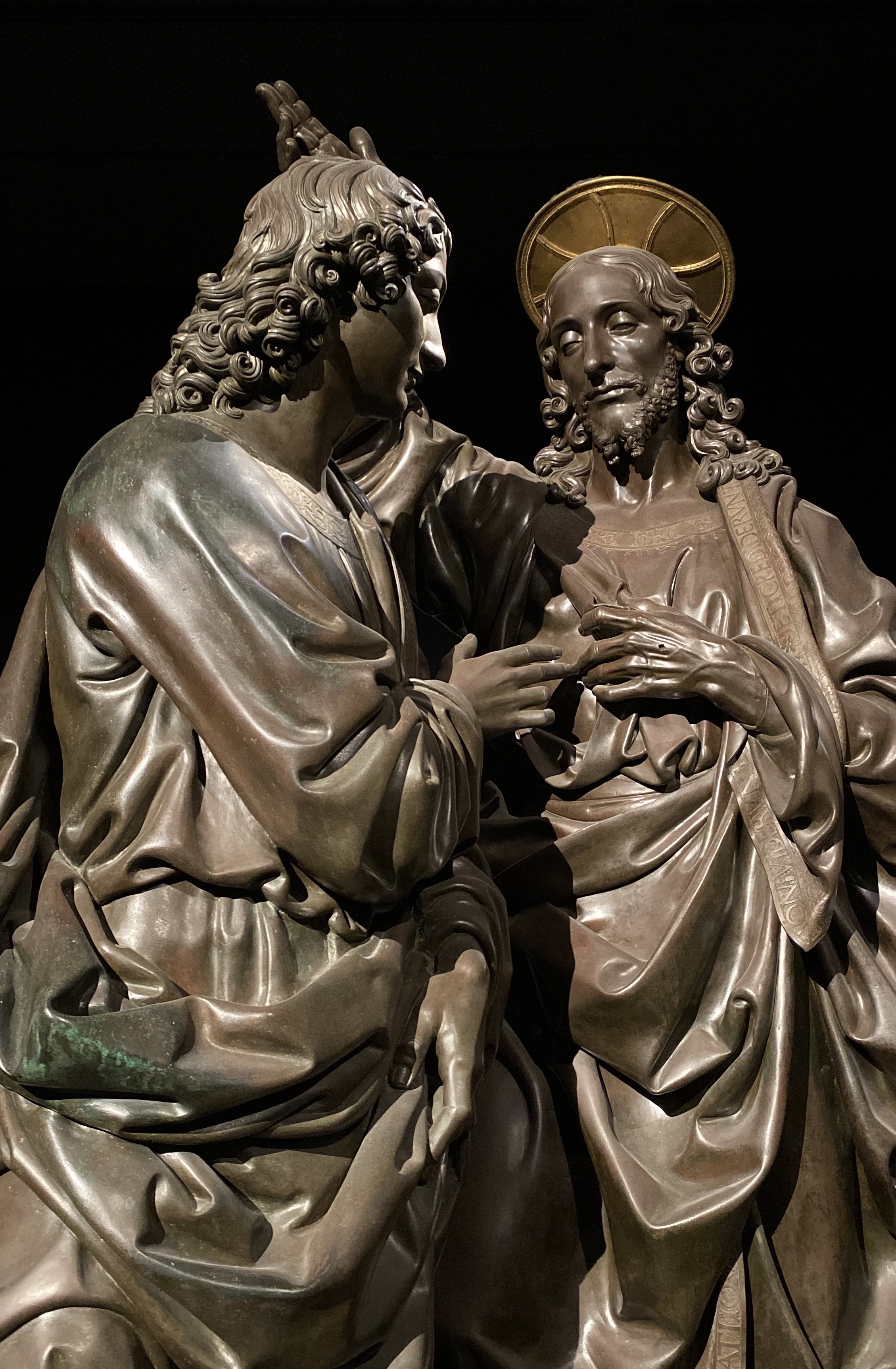
As I move on, I observe my fellow guests and how they interact with art. Most simply hold their phones up and snap a picture. I resolve to do the complete opposite and look, noting the details of every sketch and painting and sculpture and gage my reaction to it. I do, however, look at what others are drawn to and deem worth documenting: Leda’s arm around a swan, the trees in the background of the Lansdowne Madonna. I myself take pictures of a plant at water’s edge, the folds of cloth in Mary’s dress, the flour de lis on a jacket of a young boy, a minuscule horse next to a study of a nude man. I hear a chanting outside the exhibit. have no idea what they’re saying but am guessing the strike has made it’s way into the museum. Everyone’s face registers concern, but I’ve already accepted protestation as a way of life, probably almost too easily and too quickly. If they make their way here, I’ll simply move out of their way. Of course, I’ve put on my headphones and started listening to the ominous and brilliant soundtrack of “Joker” and whatever director’s eye I have is framing up the shot to film the storming of the Louvre. I really should stop listening to menacing, adrenaline-pumping scores.
The last piece I look at, likely deliberately placed, is titled, “A Deluge;” a black chalk sketch of falling water. I glance at it briefly, but feel a sense of mortality, thinking all things move into an ending; a constant and radical changing that transforms, sometimes violently and traumatically. I’m astounded by how much I can feel in such a brief moment of time.
I make my way out of the exhibit, see that museum is now open, and I head back to my original destination: the Richelieu wing, and spend more than two hours in the Morly statues garden, an enclosed courtyard of marble sculptures. There’s a delightfully romantic scene in Joe Wright’s “Pride & Prejudice” where Lizzie takes a meandering tour of Darcy’s collection at Pemberly, running her hands softly over stone curls of hair and the side of a man reclining and I desperately want to reach out and feel something cooly tangible. An empty rack of what I think houses sketchpads stands nearby and I wish I knew how to sketch and - even more so - sit still is such deep focus to capture what I’m studying. Artists in their own throes of study sit on benches and steps and stools, eyes flickering from subject to page. I notice one girl in particular, mainly because she’s in complete neon orange, but also because she seems to have a hard time starting. A few minutes later, a man comes up to her and she has the vacant stare women get when being mansplained to. He’s taken her sketch pad away and explains the movements he’s making. I keep watching, wanting to rescue her, then sheepishly realize he’s her teacher. I wander a little bit, but mainly remain in the courtyard, writing and pausing to notice the people around me. I’ve very thankful I can stop and rest - I don’t have to see the museum all at once. The acknowledgement of all my free time doesn’t happen as much as I think it should, but when it does, I almost want to laugh out loud, wondering in disbelief that his is my life. I can’t dwell on it too long or I’ll start to cry tears of confused happiness and joy.
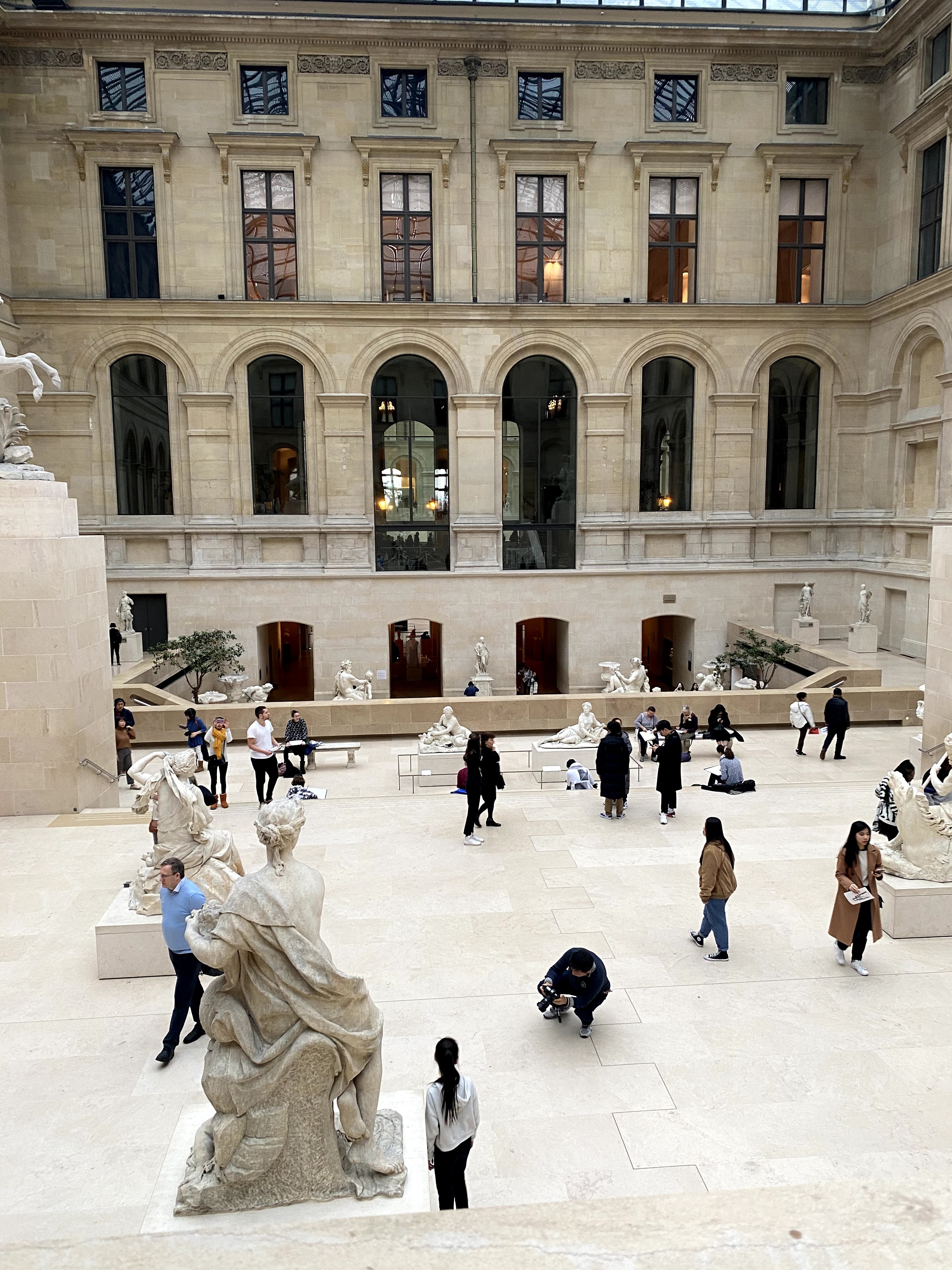
I finally decide to leave, motivated to find warmth after sitting on the cold stone steps and to find food - I’m thinking grilled cheese. Before I go, the man who’s been perched in front of me has a small sketchbook, decorated with a tattered map of the museum. Its lovely to see I’m not the only one at my leisure and I want to greet him as a fellow Louvre frequenter, even though I just started coming here.
Maybe on another trip.


Gosh, I really love that you did that at the Museum. I used to go to the Prado when I lived in Madrid and spend my lunch hour in one room, studying an artists works without trying to see anything else. I love Velasquez and Bosch of course, for just that reason. Actually, more reasons, but not enough space here to tell you about them. Enjoy!!!
I look forward to your next missive,,, Kisses from the Uncle.
For whatever the value of my personal opinion is, I think is some of the best writing I've ever enjoyed from you. It almost felt like we were touring the MFA together before stopping for lunch and exchanging Christmas presents.